Key Facts
Origins, Formation, and Colonial Prison
Le Duc Tho was born Phan Dinh Khai on 14 October 1911 in Dich Le village, Nam Dinh Province, in the Red River Delta of northern Vietnam — a region with a long tradition of Vietnamese scholar-officials and, by the early twentieth century, a growing tradition of anti-colonial political activism. His family was educated and politically aware, and he was drawn into nationalist politics in his teenage years, at a time when organised anti-colonial resistance in Vietnam was beginning to coalesce around the new communist and nationalist parties emerging from contact with international revolutionary movements.
He was among the founding members of the Indochinese Communist Party in 1930, joining in its earliest months when the organisation existed as a small underground network of cells spread across French Indochina, connected by clandestine couriers and maintained at constant risk of French colonial police infiltration. He was nineteen years old. Membership was not a career choice; it was an acceptance that arrest, imprisonment, and possible execution were likely consequences.
The arrest came quickly. Tho was first detained in 1930 and would spend much of the following fifteen years in French colonial prisons — including the notorious Con Dao island prison off the southern coast of Vietnam, known to the French as Poulo Condore, where the colonial administration concentrated its most dangerous political prisoners. Con Dao was not merely confinement. It was a regime of systematic brutality: physical abuse, enforced malnutrition, forced labour in suffocating heat, prolonged solitary confinement. The mortality rate among prisoners was high. Those who survived emerged not broken but hardened — with stronger convictions, wider political networks, and an experiential understanding of suffering that gave their subsequent leadership a particular gravity that no political education alone could have supplied.
Con Dao was also, paradoxically, an extraordinary gathering of Vietnamese revolutionary talent. Prisoners from across the country were concentrated in a single location, and in the spaces between work and punishment they argued politics endlessly, ran clandestine educational programmes, trained one another in Marxist theory and organisational method. Le Duan was among those imprisoned there simultaneously. The networks of personal trust and political understanding that were forged at Con Dao would sustain the Vietnamese revolutionary leadership through the decades of struggle ahead.
Tho was released in 1945 during the upheaval of the August Revolution and threw himself immediately back into organisational work. He had spent most of the previous fifteen years in prison. He was thirty-three years old and had barely begun.
Party Organiser and Politburo Figure
Le Duc Tho's particular strength, and the role that made him irreplaceable to the Vietnamese revolutionary movement for four decades, was party organisation. He was not a military commander in the mode of Vo Nguyen Giap, nor a charismatic public symbol in the mode of Ho Chi Minh. He was the man who built and maintained the organisational infrastructure of the Party itself: the structures through which cadres were trained, assigned, and disciplined; the mechanisms through which political line was transmitted from the Politburo to the base; the processes through which the Party maintained cohesion under conditions of extreme and sustained pressure.
He became a member of the Politburo in 1955 and remained one of the most powerful figures in Vietnamese politics for the next three decades. His specific portfolio included oversight of Party organisation and, critically, direct supervision of the Party's work in the south throughout the war years. This meant maintaining the political and organisational networks of the National Liberation Front and the underground Party apparatus in South Vietnam under conditions of constant American bombing, systematic counterinsurgency operations, and the Phoenix Program — a CIA-designed campaign that resulted in the assassination or capture of tens of thousands of NLF cadres and sympathisers between 1965 and 1972.
His work was, by its nature, largely invisible to the outside world. Party organisers do not give speeches on balconies or lead armies across battlefields. They recruit, train, assign, evaluate, and maintain the people who do. The effectiveness of the Vietnamese revolutionary movement's political organisation — its ability to sustain itself over decades, to maintain ideological coherence, to rebuild after devastating military setbacks, to function in villages across South Vietnam even as American search-and-destroy operations swept through them — was in significant part a product of the institutional work that figures like Tho performed, without publicity, for thirty years.
During the war, Tho made multiple personal trips to the south, travelling along the Ho Chi Minh Trail under American bombing — a physically dangerous undertaking that his position did not require and that he performed anyway. His willingness to share the physical risks imposed on ordinary cadres was part of his credibility as a leader.
The Paris Peace Talks
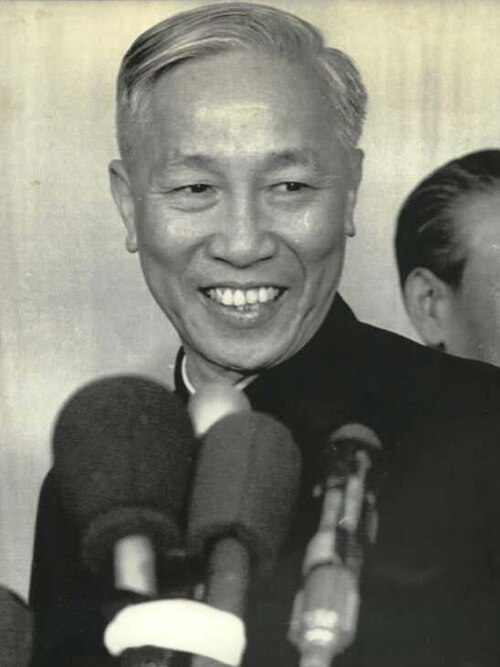
Le Duc Tho was appointed as the senior Vietnamese representative for the secret negotiations with the United States that ran parallel to the official Paris Peace Conference between 1970 and 1973. His American counterpart in these private talks, conducted at a private house in the Paris suburb of Gif-sur-Yvette, was Henry Kissinger — at that point National Security Advisor to President Nixon and one of the most formidable diplomatic operators in the world.
The negotiations were, by all accounts, exhausting and at times infuriating for both sides. Kissinger was experienced, well-resourced, and backed by the most powerful nation on earth. He arrived at sessions with clear American interests, sophisticated analytical frameworks, and considerable personal charm deployed in service of specific objectives. Tho arrived with a strategic goal — complete American military withdrawal and a political settlement that would not permanently partition Vietnam — and a patience that Kissinger later described with something approaching bewilderment as essentially inexhaustible. This was not surprising. Tho had spent fifteen years in colonial prisons. He had been organising underground resistance for forty years. He was not a man who found waiting, or discomfort, or the deliberate prolongation of difficult conversations, particularly difficult to endure.
The talks were interrupted in December 1972 when President Nixon, frustrated with the pace of negotiations and seeking a stronger position, ordered the Christmas Bombing — the most intensive bombing campaign of the entire war against North Vietnam. For eleven days, B-52 bombers struck Hanoi and Haiphong, killing several thousand Vietnamese civilians, destroying hospitals, residential districts, and the Bach Mai Hospital — one of Hanoi's principal medical facilities. The bombing generated immediate and sustained international outrage. It did not produce the concessions Nixon sought. Talks resumed in January 1973, and the Paris Peace Accords were signed on 27 January with terms not materially different from those on the table before the bombing began.
The Accords provided for a ceasefire in place, the withdrawal of all American military forces within sixty days, the release of American prisoners of war, and the recognition of two parallel administrations in South Vietnam pending political settlement. Crucially for the subsequent military balance, the Accords did not require North Vietnamese forces already positioned in the south to withdraw. American forces would leave; North Vietnamese forces would remain. The asymmetry was fundamental, and it was not accidental.
When the Nobel Committee announced the 1973 Peace Prize would be awarded jointly to Kissinger and Tho, the decision was immediately controversial. Two members of the Nobel Committee resigned in protest. Kissinger accepted the prize, though he later offered to return it when the fighting resumed. Tho declined his share entirely. His statement was brief and precise: peace had not been established in Vietnam and therefore the basis for the award did not exist. He was the first person in the history of the Nobel Prize to decline it, and he remains the only one who declined it on the grounds that the peace it was meant to honour had not actually been achieved. He was correct. The war continued for two more years. Saigon fell in April 1975.
After Reunification
Following Vietnam's reunification in 1976, Tho continued as a senior Politburo member responsible for Party organisation in the unified state. The post-war period presented challenges of a different character: building functional administrative structures in a deeply divided south, managing the difficult process of social and economic transformation, and navigating Vietnam's deteriorating relationships with both China and the Khmer Rouge government in Cambodia.
He played a significant role in the decisions that led to Vietnam's military intervention in Cambodia in late 1978, which removed the Khmer Rouge government and brought an end to the genocide it had been conducting against the Cambodian population — a genocide that, by 1978, had killed an estimated 1.5 to 2 million people. The intervention drew immediate military retaliation from China in the border war of 1979, launched in support of the Khmer Rouge's ousted leadership, and prolonged Vietnam's international isolation for over a decade. That the intervention ended the killing fields of Cambodia is a fact the international community was slow to acknowledge, having imposed an economic and political quarantine on Vietnam throughout the period of its Cambodian occupation.
Tho retired from the Politburo in 1986, the same year as Le Duan's death and the adoption of the Doi Moi economic reforms that began opening Vietnam to market economics. He spent his final years in Hanoi and died on 13 October 1990, one day before what would have been his seventy-ninth birthday. He is buried in Mai Dich Cemetery in Hanoi, reserved for Vietnamese leaders of exceptional distinction.
Legacy
Le Duc Tho's place in the history of the Vietnamese revolution is secure, though the nature of that place requires careful framing. He was not the kind of revolutionary leader whose image hangs in public squares or whose name is given to major cities. His work was largely institutional and conducted out of public view, and the effects of that work — the organisational resilience that allowed the Vietnamese revolutionary movement to sustain itself through decades of repression and warfare — become visible only in retrospect, when you understand how unusual it is for a clandestine political organisation to maintain its coherence, its discipline, and its popular legitimacy across three decades of sustained assault.
His refusal of the Nobel Peace Prize remains his most widely cited act outside Vietnam, and it deserves the significance it is usually accorded. It was not a symbolic gesture; it was a precise political statement from someone who had spent forty years in the revolutionary underground and knew exactly what he was saying. The Accords were a framework for American withdrawal, not for peace. The war would continue until Vietnam determined its own outcome on its own terms. That is what happened. And the man who said so plainly, at the moment when he could have accepted international honour for a peace that did not yet exist, was telling a truth that most of the world was not yet ready to hear.
Within Vietnam, his legacy is officially respected. The broader post-war policies with which he was associated — including the re-education camp system and the pace of southern collectivisation — are regarded more critically in contemporary Vietnamese historical discourse than the heroism of his wartime role. That tension between the revolutionary achievement and the post-revolutionary governance it produced is one that the Vietnamese historical record continues to negotiate, within the constraints that a one-party state places on that process.