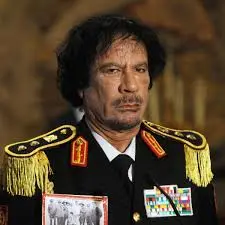
At a Glance
Sirte, the Bedouin World, and the Formation of a Revolutionary
Muammar Gaddafi was born on 7 June 1942 in a tent in the desert near Sirte — not a metaphor but a literal description of the circumstances of his birth, in a Bedouin pastoral family of the Qadhadhfa tribe that moved with its herds across the Sirte Basin between the Mediterranean coast and the interior. The Bedouin world of the Sirte Basin was marginal to the Libyan political and economic elites of both Cyrenaica and Tripolitania — the merchant families of Tripoli, the landed gentry and religious aristocracy of Cyrenaica — and growing up in this world gave Gaddafi both a deep identification with what he would later call "the masses" and a lasting resentment of the established elites whose social world had no room for someone of his background.
His political formation came at Sabha secondary school, where he encountered the pan-Arab nationalist ideas that Gamal Abdel Nasser was broadcasting across the Arab world through Radio Cairo. Nasser's Egypt — the revolutionary republic that had overthrown the monarchy, nationalised the Suez Canal, challenged Western imperialism, and asserted Arab dignity in the face of decades of colonial humiliation — was the political model that the young Gaddafi absorbed with a totality that would shape the rest of his life. He would spend forty years trying to be Nasser, with Libya as Egypt, and the pan-Arab world as his arena.
The military academy and the subsequent training in Britain completed his professional formation. He was a competent but not brilliant military officer, and his political gifts — for oratory, for the manipulation of political symbols, for the projection of personal authority — were more important than his military skills. The Free Officers Movement that he organised in the Libyan army in the late 1960s was modelled explicitly on Nasser's Free Officers, and the 1969 coup that it executed was consciously the Libyan equivalent of Egypt's 1952 revolution.
The 1969 Coup: Nasser's Disciple Seizes His Moment
The coup of 1 September 1969 was executed while King Idris was in Greece receiving medical treatment — a timing that was partly coincidental and partly calculated, since the eighty-year-old king's absence from the country reduced the risk of loyalist resistance. The Free Officers had been planning the coup for years, identifying the key military installations and communication points that needed to be controlled simultaneously, ensuring sufficient support within the army to prevent counter-action, and preparing the political messaging that would justify the new government to the Libyan public and to the international community.
The coup was bloodless and swift. By the time Radio Benghazi broadcast the announcement of the revolution in the early hours of 1 September — a broadcast that began with a verse from the Quran and then announced the overthrow of the "reactionary and corrupt regime" — the key installations were already secured. The Revolutionary Command Council that Gaddafi headed became the governing body of the Libyan Arab Republic, the monarchy was abolished, and a new era in Libyan history had begun.
Gaddafi was twenty-seven years old. He had been inspired by a revolution that had occurred when he was ten. He had spent his adolescence and early adulthood planning to replicate it in Libya. He had succeeded. He would spend the next four decades trying to decide what to do with his success.
Oil, Nationalisation, and the Assertion of Sovereignty
The two most immediate acts of the new government — the expulsion of American and British military bases and the renegotiation of the terms under which Western oil companies operated — were expressions of the anti-imperialism that was the most consistent thread running through Gaddafi's political career. The American Wheelus Air Force Base and the British El Adem Air Base were symbols of the post-independence dependency that the Idris government had accepted as the price of Western support, and their removal was a statement that Libya under Gaddafi would not be a client state of the Western powers.
The oil negotiations were more complex. Gaddafi did not immediately nationalise the oil industry but instead pursued an aggressive programme of renegotiation — demanding higher royalties, greater Libyan participation in production, and eventually majority state ownership — that fundamentally altered the balance of power between the Libyan state and the Western oil companies. The OPEC oil embargo of 1973 and the dramatic increase in oil prices that followed gave the Libyan government revenues that transformed its ability to pursue its domestic and international agenda. A country that had been one of the poorest in the world in 1951 became, within two decades, one of the wealthiest per capita in Africa.
The Green Book and the Jamahiriya
The Green Book — published in three volumes between 1975 and 1979 — was Gaddafi's attempt to develop an original political philosophy that transcended the Cold War's capitalism-versus-communism framework. The Third Universal Theory, as he called it, rejected both the parliamentary democracy of the capitalist West (which he argued was a form of bourgeois class rule disguised as popular sovereignty) and the Marxist dictatorship of the proletariat (which he argued had replaced one form of domination with another). In their place he proposed the Jamahiriya — the "state of the masses" — in which political authority was exercised directly through People's Congresses and economic production was organised through self-managing cooperatives.
The theory was genuinely original — a product of Gaddafi's eclectic reading and his determination to articulate a political philosophy that was distinctly Libyan and distinctly Islamic rather than imported from either the Western or the Soviet tradition. Whether it was coherent is a different question: critics have pointed to the contradictions between the Green Book's assertions of direct democracy and the reality of Gaddafi's personal rule, between its Islamic foundations and its rejection of traditional Islamic governance, and between its celebration of the masses and its contempt for the political capacity of ordinary people to govern themselves without Gaddafi's guidance.
The Jamahiriya in practice was an authoritarian state in which power was exercised by Gaddafi personally, by the Revolutionary Committees that enforced his will at every level of society, and by the security apparatus that suppressed dissent with methods that included arbitrary arrest, torture, and extrajudicial killing. The People's Congresses existed and met and debated, but their decisions on matters of significance were constrained by the Revolutionary Committee system and by Gaddafi's own interventions. The gap between the theory and the practice was vast, and it was the gap that the 2011 uprising eventually made visible to the world.
The Patron of Liberation Movements
Gaddafi's financial and material support for liberation movements around the world is the dimension of his rule most relevant to the Freedom History Project's subject matter. The list of organisations that received Libyan support across four decades is remarkable in its breadth: the Palestine Liberation Organisation, the Irish Republican Army, the African National Congress, the Polisario Front fighting for Western Saharan independence from Morocco, the Moro National Liberation Front in the Philippines, various revolutionary organisations in Latin America, and dozens of others. The support was not simply rhetorical — it included weapons, training in Libyan facilities, financial transfers, and diplomatic support at the Arab League and the Organisation of African Unity.
The motivation for this support was a combination of genuine anti-imperial conviction, strategic calculation, and personal ambition. Gaddafi genuinely believed — in the way that makes belief most powerful, with the full commitment of someone who has never had reason to doubt — that the Western powers were the source of the world's principal political evils and that the liberation of oppressed peoples from Western imperialism was the central moral and political project of the age. Supporting liberation movements was the expression of this belief in the most concrete form available to someone with Libya's oil revenues.
The strategic calculation was that Libyan support for liberation movements created political relationships and geopolitical influence that Libya's size and population did not naturally command. A country of a few million people in North Africa, however rich in oil, was not naturally a major power; but a country that funded the IRA's arms purchases, supplied the PLO with weapons, and provided training facilities for revolutionary movements from Belfast to Johannesburg could claim a role in the politics of regions far beyond its geographical position.
Terrorism, Lockerbie, and the International Pariah
The support for liberation movements shaded, in certain cases, into the sponsorship of operations that killed civilians in ways that the international community classified as terrorism. The most catastrophic of these was the Lockerbie bombing of 21 December 1988, in which a bomb placed in the cargo hold of Pan Am Flight 103 exploded over the Scottish town of Lockerbie, killing all 259 people on board and 11 people on the ground. The subsequent investigation established Libyan responsibility — two Libyan intelligence officers were charged, one was convicted — and Libya was subject to UN Security Council sanctions that isolated it diplomatically and economically through the 1990s.
The reconciliation of 2003 — in which Gaddafi accepted responsibility for Lockerbie, paid compensation to the victims' families, and announced the abandonment of Libya's weapons of mass destruction programme — was one of the most dramatic diplomatic reversals of the post-Cold War era. Within months of the reconciliation, Western leaders who had spent years condemning Gaddafi were visiting Tripoli, Western oil companies were returning to Libya's oil fields, and the international sanctions that had defined Libya's position for a decade were being lifted. The reconciliation came at the cost of the anti-imperialist posture that had defined Gaddafi's international identity, and it reflected the pragmatic calculation — reinforced by the American invasion of Iraq in 2003 — that the Western powers' willingness to use military force against regimes they defined as hostile made accommodation more prudent than continued confrontation.
Pan-Africanism and the African Union
As Arab nationalism's aspiration toward pan-Arab unity was frustrated — by the failed Egyptian-Syrian union, by the divisions of the Arab world, by the Oslo process that seemed to accept the permanence of Israel — Gaddafi shifted his primary political identification increasingly toward Africa. The Pan-Africanism that he championed in the 2000s was expressed in financial support for African institutions and governments, in advocacy for African political unity through a United States of Africa, and in his investment in the transformation of the OAU into the African Union in 2002.
His African engagement was taken more seriously by African leaders than his Arab engagement had been — partly because Libya's oil wealth made his financial commitments credible, and partly because the Pan-African aspiration to continental unity resonated with a tradition that went back to Kwame Nkrumah and the founders of the OAU. His annual appearances at African Union summits — arriving in elaborate robes, accompanied by large delegations of female bodyguards, holding extended press conferences and bilateral meetings — became one of the defining spectacles of African diplomatic life in the 2000s.
2011: The Arab Spring and the End
The Arab Spring uprisings that began in Tunisia in December 2010 and spread across North Africa and the Middle East created the conditions for the Libyan Civil War of 2011. Protests in Benghazi in February 2011 — inspired by the Tunisian and Egyptian uprisings and fuelled by long-standing grievances about the Gaddafi government's political repression, economic corruption, and the marginalisation of Cyrenaica — were met with violence that rapidly escalated into armed conflict. The UN Security Council authorised a no-fly zone and measures to protect civilians, which NATO interpreted broadly to include active military support for the rebels through airstrikes on Gaddafi's forces.
The NATO intervention transformed a conflict that Gaddafi's forces appeared to be winning into one that his forces eventually lost. Over eight months of civil war, the rebel forces — supplied and supported by NATO airpower and by weapons from Qatar and other Gulf states — advanced from their Cyrenaican base to Tripoli and eventually to Sirte, Gaddafi's hometown, where the final fighting concentrated in October 2011.
On 20 October 2011, Gaddafi was found hiding in a drainage pipe near Sirte. He was pulled out, beaten by rebel fighters, and shot. The circumstances of his death — the manner of it, the fact that he was captured alive and then killed, the display of his body in a commercial refrigerator in Misrata — were the subject of international condemnation of a different order from any that had been directed at his decades of authoritarian rule. He was sixty-nine years old.
Legacy: The Contradictions of an Irreducible Figure
Muammar Gaddafi's legacy is one of the most complex and contested in modern African history. He was a genuine anti-imperialist who used Libya's oil wealth to support liberation movements across the world at a time when those movements needed material support and when the Western powers were opposing them. He was a sponsor of terrorism who killed hundreds of civilians in bombings that had no legitimate military justification. He was a political theorist who wrote a book that was read and discussed around the world. He was an authoritarian ruler who imprisoned, tortured, and killed people who challenged his authority. He was a Pan-African visionary who invested in African institutions and African unity with an energy and a commitment that few other African leaders matched. He was a megalomaniac whose personal cult consumed the political institutions that a functioning state requires.
For the history of the liberation movements that the Freedom History Project documents, his most important legacy is the material support he provided to organisations fighting for freedom and independence in the 1970s and 1980s — the weapons and money and training facilities that went to the ANC, the PLO, the Polisario Front, and others at moments when they were facing Western-backed opponents with far greater resources. Whether the support he provided to the IRA and to the organisations that conducted bombings and assassinations in Western countries is part of a continuous anti-imperial project or a morally distinct category of political violence is a question that the historical record does not resolve — and that the traditions of different liberation movements answer differently.
He ruled Libya for forty-two years. He was killed by the people he claimed to have liberated. He was found in a drainage pipe. The manner of his death, like the manner of his life, defied the conventional categories of political biography. He was, whatever else he was, irreducible.